A small cubic cage was needed, to protect potted strawberry plants from birds. I had twelve pieces of 43 mm (w) width by 20 mm waste wood to hand, each of which could be trimmed to about 610 mm in length (using a stop, for consistency).
Design
The design was two square frames with mitred corners, connected at the corners with the remaining four pieces.
Construction
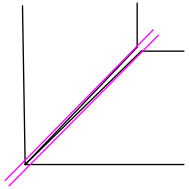
The main challenge in construction was the precision of the 45° mitre cuts. If they were each short by \theta then (if the other corners were glued flat) two opposite corners could have inner gaps of up to:
\frac {4 \sqrt {2} \cos \theta \sin \theta} {\cos \theta + \sin \theta} w
I relied on the preset stop on my mitre saw and ended up with opposite inner gaps of about 2 mm, implying the stop was about 0.5° off. That was difficult to detect until the pieces were fitted together.
The corners were to be glued with PVA wood glue, so a good fit was important for the strength of the joint. As the kerf of the saw was about 2.6 mm and it had a laser guide, I was able to improve the fit by cutting along the axis of the gap. Jigs were used to allow clamping across the mitred corners.
The connecting pieces were glued and screwed into place with two 3.5 mm by 35 mm screws at each end, the screws acting as clamps while the glue cured. A jig was used to drill guide holes in the frames. Those joints would also add a little additional strength to the mitre joints.